
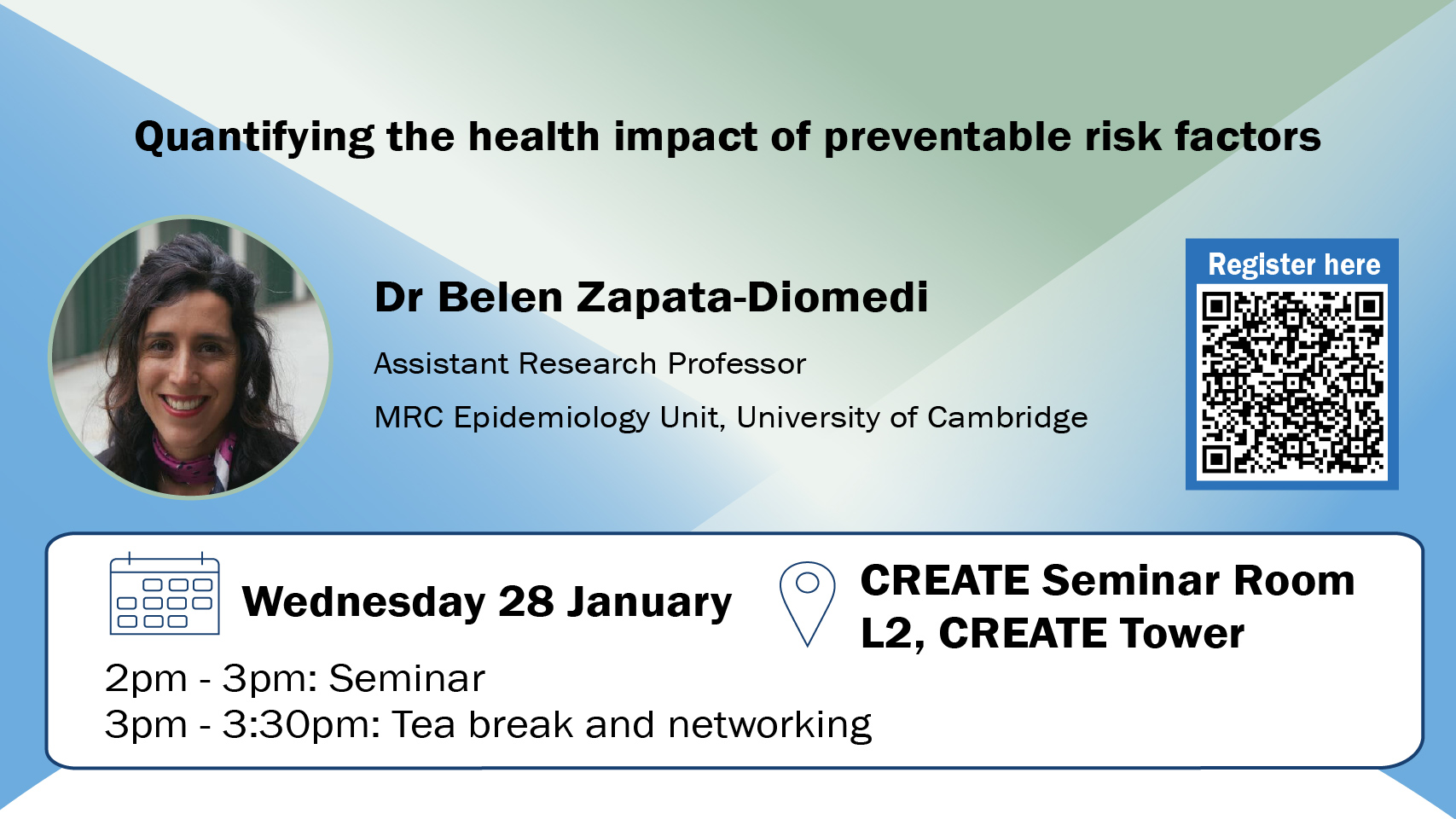
HD4 Seminar: Quantifying the health impact of preventable risk factors
Date/Time
Date(s) - January 28, 2026
2:00 PM - 3:30 PM
Date/Time
Date(s) - January 28, 2026
2:00 pm - 3:30 pm
Location
CREATE Tower
Categories No Categories
CARES will hosting the first Health-driven design for cities (HD4) seminar of 2026, taking place on 28 January, from 2:00PM to 3:30PM at the CREATE Tower. The HD4 research programme investigates how individuals live and move in Singapore, how the urban environment shapes their exposure to health risks and how this influences their overall behaviour and health.
The seminar will be led by Dr Belen Zapata-Diomedi, HD4 Co-Principal Investigator and Assistant Research Professor at the University of Cambridge MRC Epidemiology Unit. Dr Zapata-Diomedi will introduce the core principles of Quantitative Health Impact Assessment (qHIA), which comprise analytical methods used to estimate the potential consequences of changes in population levels of exposure and behaviour. The seminar will highlight how projects such as HD4 can apply qHIA methods to inform healthier and more equitable policies for Singaporeans.
Please find the details of the seminar below.
Seminar Information
Seminar Topic: Quantifying the health impact of preventable risk factors
Speaker: Dr Belen Zapata-Diomedi
Date: 28 January 2026
Time: 2:00 PM – 3:30 PM
Location: CREATE Seminar Room L2, CREATE Tower
Dr Zapata-Biomedi’s abstract: Quantitative Health Impact Assessment (qHIA) encompasses a variety of analytical methods used to estimate the potential health consequences of changes in population levels of exposure or behaviour. It is widely applied to assess both existing disease burdens such as lung cancer cases attributable to exposure to current levels of air pollution, as well as evaluate the potential health impacts of alternative scenarios, for example reduction in cancer incidence resulting from improved air quality. In this talk, Dr Zapata-Diomedi will introduce the core principles of qHIA, compare commonly used methods and illustrative case studies. The session will conclude with a discussion on how projects such as HD4 can apply qHIA to inform healthier and more equitable policies for Singaporeans.