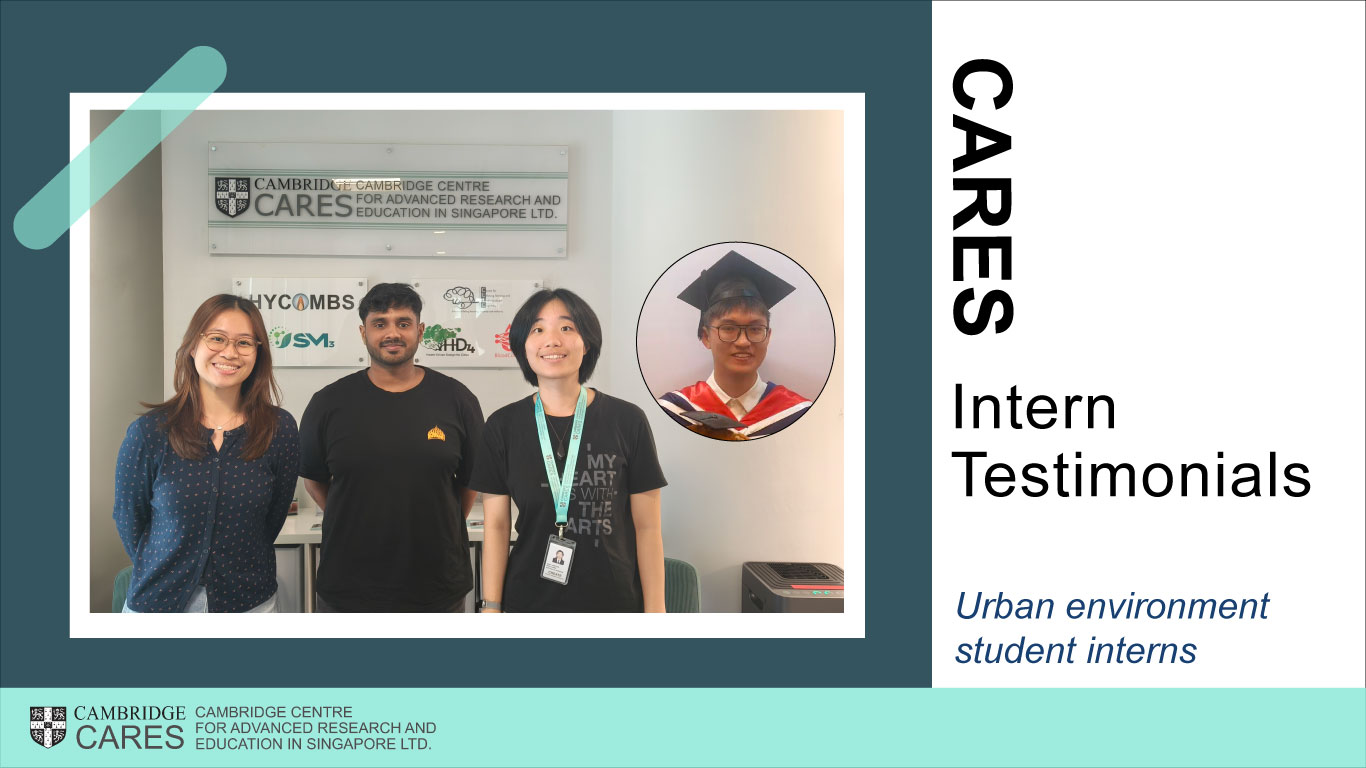
From left to right: Yew Ying Jie, Harish Manisekaran, and Qun Chen, with Peilin Li (pictured separately in the inset).
The Health-driven design for cities (HD4) programme is an ambitious endeavour to investigate the influence of Singapore’s urban environment on residents’ behaviour and health decisions. The research group consists of diverse experts from urban architecture, epidemiology, to computer science.
This provided an opportunity for the first batch of HD4 interns to explore unique research questions and get first-hand experience working on a large research programme with multiple moving parts.
HD4 hosted four interns from March to July 2026:
1. Harish Manisekaran, Bachelor of Science (Honours) at the National University of Singapore
2. Qun Chen, Bachelor of Science (Honours) in Mathematics and Bachelor of Computing (Honours) in Computer Science at the National University of Singapore
3. Yew Ying Jie, Bachelor of Science in Economics and Data Science at Nanyang Technological University
4. Peilin Li, Masters student at National University of Singapore
Geospatial analysis for environmental factors in Singapore
Harish and Qun Chen both worked with geospatial data and remote sensing software to better evaluate environmental factors in Singapore. They deepened their knowledge beyond the classroom by learning how to create independent workflows to an open-ended research question.
“I progressed from classical geostatistical methods like IDW and Ordinary Kriging through Field-based Regression Kriging, eventually developing a Multi-Task Attentive Neural Process model for wind speed prediction that outperformed the earlier approaches. This gave me hands-on experience with the full arc of a research problem,” said Harish.
Qun Chen mapped urban tree canopy data, citing the internship as one that “deepened my understanding of remote sensing and the existing technologies and methods used to detect and recognise objects in satellite and aerial imagery…The experience also gave me valuable inspiration for the areas I may explore in my future career and further studies.”
Generating data from spatial geometry and the real environment
Peilin used his past experience in architectural spatial understanding, image data processing, and machine learning methods to help HD4 researchers transform building and floor-plan geometry into data for spatial analysis.
“The team discussions were very inspiring to me. I learned a great deal from supervisors and colleagues with different research backgrounds, especially in how to articulate research questions more clearly, discuss technical approaches, and connect model-based methods with practical application scenarios,” he says.
Ying Jie shared a different experience as her internship involved fieldwork to deepen HD4’s knowledge of the food retail environment in Singapore, specifically around the Bedok Central neighbourhood, recording data on food outlet type and cross-checking that against official records from the Singapore Food Agency (SFA).
Ying Jie concludes that her internship was an “opportunity to plan fieldwork approaches and take ownership of my fieldwork project from its conception through to completion…, I valued being able to participate in large-scale seminars and work package meetings. These experiences gave me a front row view into the depth of research happening not only within HD4 but across the CREATE campus.”
We thank the HD4 supervisors, Wang Yuan, Xu Tang (Shawn), Assoc Prof Rudi Stouffs, Prof Thomas Burgoine, and Dr Lucia Segovia de la Revilla, for providing guidance and creating an environment that allowed the freedom to explore, a key factor that Harish, Qun Chen, Ying Jie, and Peilin felt most valuable to their growth.